 Bibiserv
Why Passing Audits Is Not the Same as Being Secure
Government systems sit at the center of national security, public safety, and citizen trust. From defense logistics and healthcare platforms to financial systems and emergency response networks, failure is not an option.
Yet across federal environments, one dangerous misconception persists: compliance equals security.
Agencies work tirelessly to satisfy frameworks such as NIST, FedRAMP, FISMA, and DoD RMF. Audits are passed. ATOs are granted. Documentation is pristine.
And still, breaches happen.
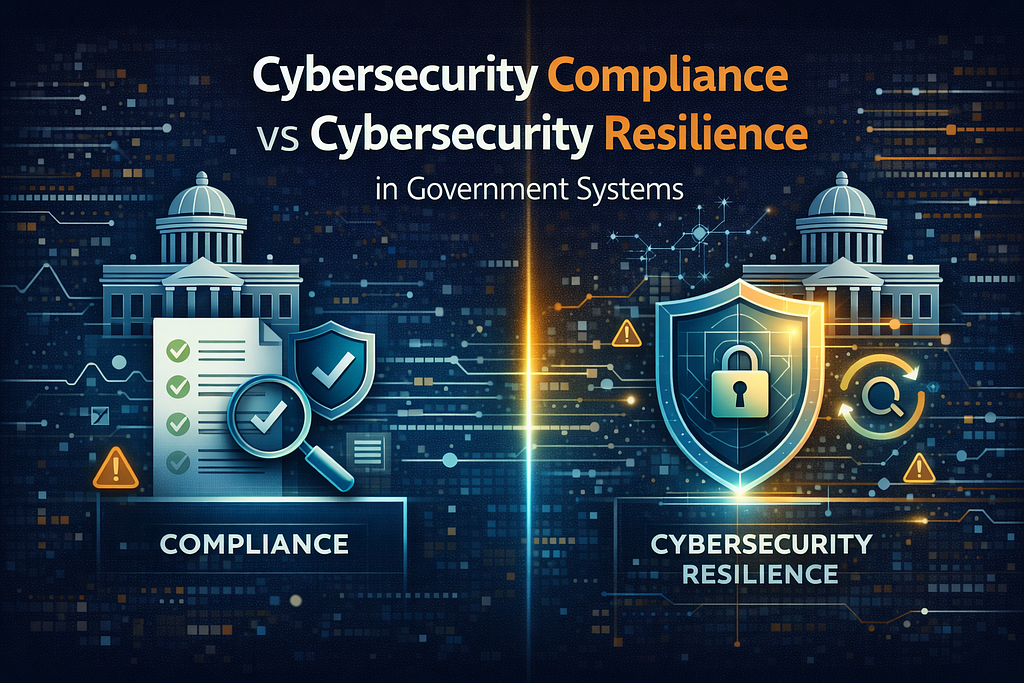
The reality is simple: compliance validates paperwork. Resilience validates survival.
Compliance: Necessary, but Incomplete
Cybersecurity compliance exists to establish a baseline. It ensures agencies implement required controls, document risks, and demonstrate due diligence.
That baseline matters. Without it, chaos follows.
But compliance frameworks are inherently point-in-time and control-centric. They answer questions like:
- Is encryption configured?
- Are access policies documented?
- Are controls mapped and approved?
They do not answer more critical questions:
- Can the system detect active compromise?
- Can it contain lateral movement?
- Can operations continue during an attack?
- Can teams respond in minutes, not weeks?
Attackers do not care whether a system passed its last audit. They exploit misconfigurations, trust assumptions, human behavior, and operational blind spots that compliance alone does not address.
Why “Compliant” Systems Still Fail
Threat actors today are fast, automated, and persistent. They operate inside environments long before detection, often abusing legitimate credentials and trusted paths.
In many federal systems, the weakest points are not missing controls. They are:
- Static perimeter defenses in hybrid environments
- Over-trusted internal networks
- Delayed detection due to log-only monitoring
- Manual incident response processes
- Tool sprawl without operational integration
A system can be 100% compliant and still be brittle.
And brittle systems break under pressure.
Cybersecurity Resilience: The Real Objective
Resilience shifts the conversation from prevention to endurance.
A resilient government system assumes compromise will occur and is designed to:
- Limit blast radius when it does
- Detect abnormal behavior early
- Maintain mission continuity
- Recover rapidly and decisively
Resilience is not a product. It is an operating posture.
It combines architecture, process, and culture into a security model that works under real-world conditions, not just audit review.
What Resilience Looks Like in Practice
In modern federal environments, resilience is built on a few non-negotiable principles.
Zero Trust as Architecture, Not Policy
Identity becomes the control plane. Access is continuously verified. Trust is never implicit, even inside the network.
Continuous Visibility
Logs alone are not enough. Agencies need real-time telemetry, behavioral analytics, and cross-domain correlation to detect threats as they unfold.
Operationally Integrated Security
Security tools must feed SOC workflows, incident response playbooks, and leadership decision-making. Shelfware does not create resilience.
Designed-In Recovery
Backup, restore, and failover are tested regularly. Recovery time objectives are enforced, not assumed.
People and Process Alignment
Teams know their roles before an incident occurs. Tabletop exercises, threat modeling, and red-team validation are routine.
This is how resilient systems stay online when adversaries expect them to fail.
Compliance Is the Floor. Resilience Is the Ceiling.
Federal agencies do not get to choose between compliance and resilience. They need both.
Compliance proves responsibility.
Resilience proves readiness.
In an era of persistent threats, supply chain compromise, and geopolitical cyber risk, the agencies that succeed will be those that move beyond checkbox security and invest in operational defense.
Because the mission does not pause for an audit.
A Smarter Path Forward
Resilience does not require abandoning compliance frameworks. It requires building on top of them with architecture, automation, and threat-informed design.
That shift starts with an honest question:
If this system were attacked tomorrow, would it keep working?
If the answer is unclear, it is time to look deeper.
Cybersecurity Resilience Assessment for Federal Systems
BIBISERV helps federal agencies and GovCon partners determine whether compliant systems are truly defensible.
Our Cybersecurity Resilience Assessment goes beyond control mapping to evaluate:
- Real-world attack paths and trust assumptions
- Detection and response maturity
- Zero Trust implementation gaps
- Mission impact under active threat scenarios
👉 Request a Cybersecurity Resilience Assessment
and understand whether your systems are built to pass audits — or survive attacks.