 Bibiserv
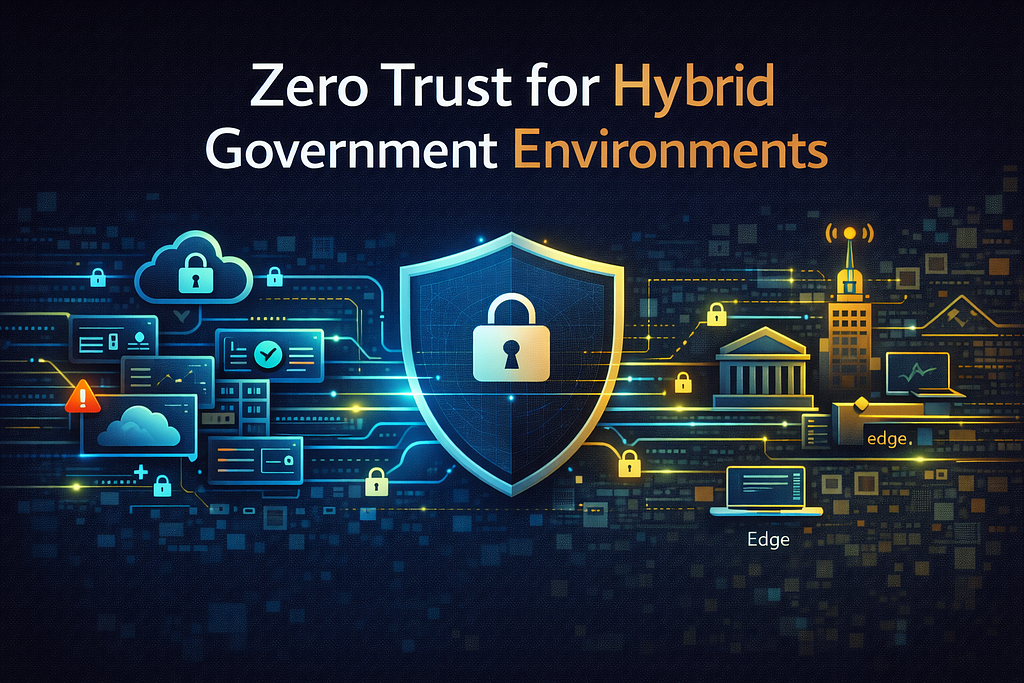
Federal agencies rarely operate in a single environment. Mission systems often span legacy data centers, private enclaves, and multiple cloud platforms. Some workloads remain on-premises due to compliance requirements or operational dependencies, while others migrate to commercial or government cloud environments to support modernization.
This hybrid reality creates both opportunity and risk.
Traditional perimeter-based security models assume that once users and systems are inside the network, they can be trusted. That assumption no longer holds. Modern threats exploit lateral movement, compromised credentials, and inconsistent controls across environments.
Zero Trust architecture addresses this challenge by shifting the security model from network trust to continuous verification. For government organizations managing hybrid infrastructures, Zero Trust provides a framework for securing access to systems and data regardless of where they reside.
The Hybrid Reality of Federal IT
Despite significant cloud modernization efforts, most federal agencies operate in hybrid environments.
Mission-critical systems may run across:
- On-premises data centers and legacy infrastructure
- Private government clouds
- Commercial cloud environments such as AWS, Azure, or Google Cloud
- Contractor-operated systems and external partner networks
These distributed architectures support mission flexibility, but they also introduce inconsistent security controls and fragmented visibility.
In many agencies, perimeter defenses were designed for centralized networks. As workloads move between environments, those defenses lose effectiveness.
Hybrid environments require security models designed for distributed access and continuous validation.
Why Hybrid Environments Create Security Gaps
Hybrid architectures expand the attack surface in several ways.
Inconsistent Security Policies
Legacy systems may rely on network-based controls while cloud platforms enforce identity-based access policies. This inconsistency creates gaps attackers can exploit.
Overtrusted Internal Networks
Traditional architectures assume internal network traffic is safe. Once attackers breach a single entry point, they can move laterally across systems.
Identity and Credential Risks
Compromised credentials remain one of the most common entry points in federal systems. Without strong identity verification and contextual access controls, attackers can masquerade as legitimate users.
Limited Visibility Across Environments
Hybrid environments often lack centralized monitoring and policy enforcement. Security teams may struggle to track activity across multiple platforms.
These gaps illustrate why perimeter-focused models are insufficient for modern government systems.
What Zero Trust Means for Federal Systems
Zero Trust replaces the concept of implicit trust with continuous verification.
Rather than relying on network boundaries, Zero Trust architectures validate every request based on identity, device posture, and contextual risk.
Three core principles guide this approach:
Verify Explicitly
Every access request must be authenticated and authorized using all available signals, including identity, device health, and behavioral context.
Use Least-Privileged Access
Users and systems receive only the permissions necessary to perform their tasks, limiting potential damage if credentials are compromised.
Assume Breach
Zero Trust assumes attackers may already be present within the environment. Systems are designed to contain and limit lateral movement.
In federal systems, identity becomes the primary security boundary rather than the network perimeter.
Applying Zero Trust Across Hybrid Architectures
Implementing Zero Trust in hybrid government environments requires coordinated changes across identity, network architecture, and monitoring capabilities.
Identity-Centric Access
Identity providers and access management platforms enforce consistent authentication policies across both on-prem and cloud environments.
Multi-factor authentication and device verification become foundational components of access control.
Microsegmentation
Applications and services are segmented into smaller security zones. Access between zones requires explicit authorization, preventing attackers from moving freely within the network.
Policy-Based Access Controls
Access decisions incorporate contextual signals such as user role, location, device compliance, and risk scores.
These policies remain consistent regardless of whether workloads run on-premises or in the cloud.
Continuous Monitoring and Analytics
Security platforms monitor behavior across environments, detecting anomalies that may indicate compromised accounts or malicious activity.
Automation helps security teams respond quickly to emerging threats.
Aligning Zero Trust with Federal Security Frameworks
Federal cybersecurity initiatives increasingly emphasize Zero Trust as a strategic priority.
Agencies implementing Zero Trust typically align their efforts with established frameworks and mandates, including:
- NIST Zero Trust Architecture guidance
- Federal Zero Trust strategy and modernization initiatives
- Risk Management Framework (RMF) controls
Zero Trust complements these frameworks by strengthening identity management, access governance, and monitoring capabilities already required by federal security programs.
Rather than replacing compliance frameworks, Zero Trust enhances their effectiveness by improving enforcement and visibility.
Practical Steps for Agencies Adopting Zero Trust
Transitioning to Zero Trust does not require immediate replacement of existing infrastructure. Agencies can adopt the model incrementally.
Effective starting points include:
Inventory Identities, Devices, and Workloads
Understanding who and what interacts with federal systems is the foundation for effective policy enforcement.
Strengthen Identity Governance
Implement strong authentication mechanisms and centralized identity management across all environments.
Segment Networks and Applications
Begin with high-risk systems and gradually expand segmentation to limit potential attack paths.
Implement Continuous Monitoring
Centralized logging, telemetry, and behavioral analytics provide visibility into activity across hybrid infrastructures.
Automate Policy Enforcement
Automation ensures consistent enforcement of security policies across distributed environments.
Incremental adoption allows agencies to improve security posture while maintaining operational continuity.
Zero Trust Is a Strategic Security Model
Hybrid federal environments are not temporary. Legacy systems, mission requirements, and modernization initiatives will continue to coexist for years to come.
Zero Trust provides a security model designed for this reality. By shifting the focus from network boundaries to identity verification and continuous monitoring, agencies can strengthen protection across both legacy and modern infrastructure.
Adopting Zero Trust is not about purchasing a single tool or platform. It is about building an architecture that consistently enforces security policies across distributed systems.
Agencies that take a structured approach to Zero Trust improve not only their cybersecurity posture but also their operational resilience.
Call to Action
Operating hybrid government environments requires security architectures designed for distributed systems and evolving threats.
BIBISERV’s Zero Trust Architecture Assessment helps federal organizations evaluate:
- Identity and access management maturity
- Segmentation strategies across hybrid environments
- Policy enforcement and monitoring capabilities
- Alignment with federal Zero Trust initiatives and RMF controls
Schedule a Zero Trust Architecture Assessment with BIBISERV to strengthen security across your hybrid infrastructure.