 Bibiserv
Government systems support services that millions of people depend on every day. Emergency response platforms, healthcare portals, benefits systems, and national security applications must remain available even during infrastructure failures, cyber incidents, or natural disasters.
In this environment, downtime is not merely an inconvenience. It can disrupt critical services, erode public trust, and impact mission outcomes.
As agencies modernize their infrastructure, cloud platforms have become a key enabler of resilience. When designed properly, cloud environments provide the scalability, redundancy, and automation necessary to keep systems operational under adverse conditions.
However, cloud adoption alone does not guarantee resilience. Availability and recoverability must be designed intentionally from the start.
Why Resilience Matters in Public Sector Systems
Public sector systems often operate under conditions where continuous availability is essential.
Examples include:
- Emergency services and public safety systems
- Healthcare and public health platforms
- Benefits and citizen services portals
- National security and defense applications
- Transportation and infrastructure monitoring systems
When these systems experience outages, the consequences can extend beyond operational inconvenience. Service interruptions may delay critical responses, interrupt access to essential resources, or create cascading impacts across government operations.
Legacy infrastructure has traditionally struggled to meet these availability requirements. Single data centers, tightly coupled architectures, and manual recovery procedures create vulnerabilities that are difficult to address quickly during disruptions.
Cloud platforms offer a different model — one built around distributed infrastructure and automated recovery.
The Cost of Downtime
System outages in government environments carry significant operational and reputational consequences.
Key impacts include:
Disrupted Public Services
Citizens rely on digital platforms to access services ranging from healthcare information to unemployment assistance. Downtime prevents access when services are needed most.
Operational Delays
Government agencies depend on interconnected systems to coordinate activities. When one system fails, downstream systems may also be affected.
Security and Incident Risks
Cyberattacks and infrastructure failures often coincide with system instability. If recovery capabilities are weak, attackers may exploit downtime to escalate access or disrupt services further.
Loss of Public Trust
When public-facing systems repeatedly experience outages, confidence in digital government services diminishes.
Resilient infrastructure is therefore not just a technical priority — it is a mission and trust imperative.
Principles of Resilient Cloud Architecture
Cloud platforms provide the building blocks for resilience, but architectural decisions determine how effectively they are used.
Effective resilient systems are designed around several key principles.
High Availability
Workloads are distributed across multiple infrastructure components so that the failure of one component does not interrupt service.
This often includes redundant compute instances, load balancing, and distributed data storage.
Geographic Distribution
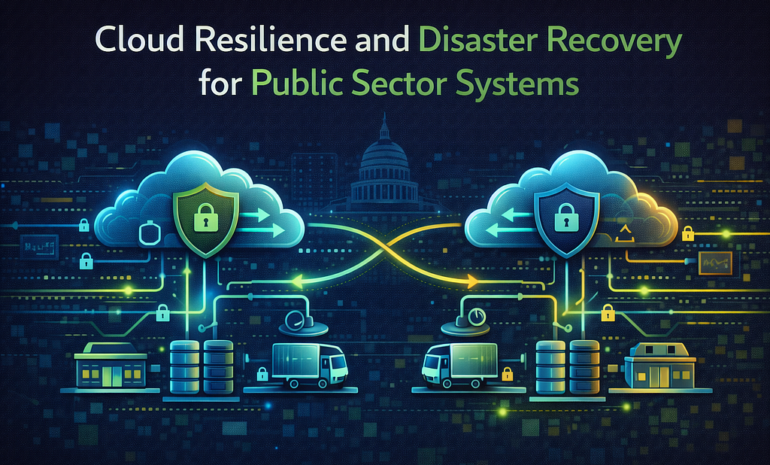
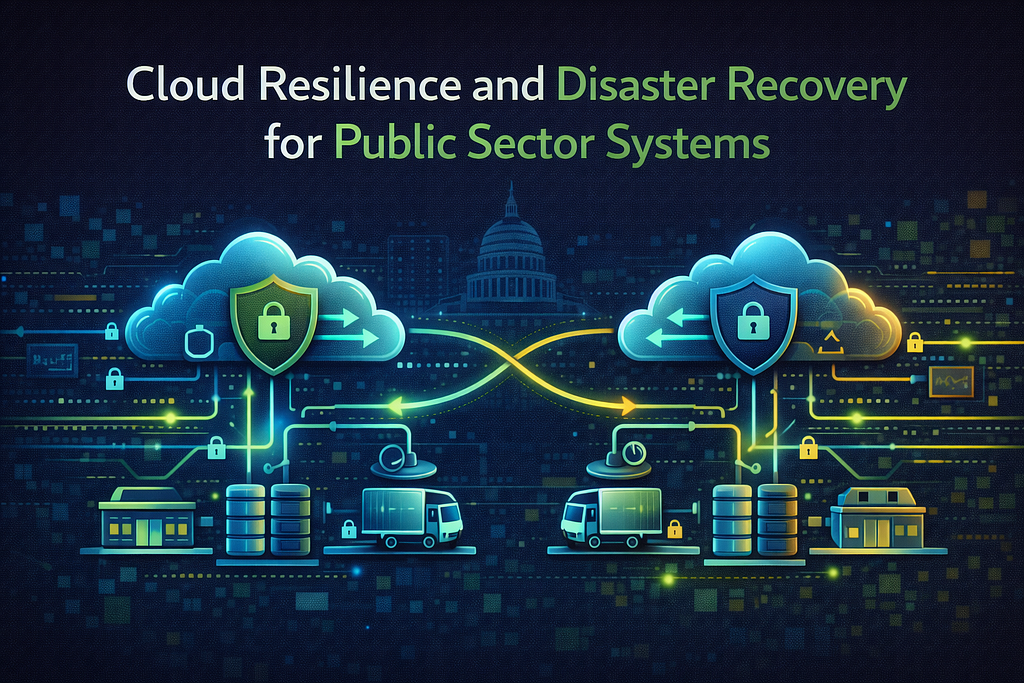
Deploying workloads across multiple regions or availability zones ensures that localized outages — such as power failures or natural disasters — do not take entire systems offline.
Fault Isolation
Systems should be designed so that failures in one service or component do not cascade across the entire platform.
Microservices architectures and segmented infrastructure help limit the impact of localized issues.
Automated Failover
Automated systems detect failures and redirect traffic or restart services without requiring manual intervention.
Automation significantly reduces downtime and recovery delays.
Disaster Recovery Strategies for Public Sector Systems
Resilience and disaster recovery are closely related but distinct concepts. Resilience focuses on maintaining operations during disruptions, while disaster recovery ensures systems can be restored quickly if failure occurs.
Effective disaster recovery strategies include the following elements.
Backup and Data Replication
Critical data should be continuously replicated to secondary locations to prevent data loss during outages.
Recovery Time Objectives (RTO)
RTO defines how quickly systems must be restored after an outage.
Public sector systems often require aggressive recovery timelines to maintain service continuity.
Recovery Point Objectives (RPO)
RPO defines how much data loss is acceptable. For many mission-critical systems, acceptable loss may be minimal or zero.
Active-Active and Active-Passive Architectures
Some systems operate simultaneously across multiple environments (active-active), while others maintain standby environments ready to assume operations if needed (active-passive).
Choosing the appropriate model depends on system criticality, cost considerations, and operational complexity.
Testing and Validation
Disaster recovery plans must be tested regularly. Simulated failovers and recovery exercises help verify that systems behave as expected during real incidents.
Aligning Resilience with Government Compliance Requirements
Public sector systems must meet strict compliance and governance standards.
Resilience strategies must therefore align with frameworks that govern federal and state IT environments. These frameworks emphasize:
- Continuous monitoring of system health
- Documented recovery procedures
- Traceable and auditable operational controls
- Integration of resilience planning into broader risk management programs
Cloud environments can help agencies meet these requirements by providing built-in monitoring, logging, and automation capabilities that support compliance reporting and incident response.
Building Operational Resilience
Technology alone does not create resilience. Operational practices must support the architecture.
Key operational practices include:
Infrastructure as Code
Infrastructure defined through code allows agencies to deploy and recover environments consistently and rapidly.
Automated Monitoring and Alerts
Continuous monitoring enables teams to detect anomalies early and respond before they escalate into outages.
Automated System Healing
Cloud-native systems can automatically restart failed components or redistribute workloads when failures occur.
Integrated Incident Response
Monitoring, security, and operations teams must coordinate effectively during incidents to restore service quickly.
Continuous Resilience Testing
Organizations should regularly evaluate system resilience through controlled failure simulations and recovery exercises.
These practices ensure that resilience is maintained over time as systems evolve.
Resilience Must Be Designed from the Start
Modern cloud platforms offer powerful tools for building resilient systems, but resilience is not automatic.
Organizations must intentionally design architectures that prioritize availability, fault tolerance, and recoverability. Systems that incorporate redundancy, automation, and distributed infrastructure are far better equipped to withstand disruptions.
For public sector organizations, resilience is not optional. It is a foundational requirement for delivering reliable digital services and maintaining operational continuity.
By investing in resilient cloud architectures and robust disaster recovery strategies, agencies can ensure that critical systems remain available — even when the unexpected occurs.
Call to Action
Public sector systems must remain available even during outages, cyber incidents, or infrastructure disruptions.
BIBISERV’s Cloud Resilience & Disaster Recovery Assessment helps agencies evaluate:
- Cloud architecture resilience and availability
- Disaster recovery readiness and recovery objectives
- Monitoring, automation, and failover capabilities
- Alignment with government security and compliance frameworks
Schedule a Cloud Resilience & Disaster Recovery Assessment with BIBISERV to strengthen the resilience of your mission-critical systems.